Open@VT

Open Access, Open Data, and Open Educational Resources

Book Review: Issues in Open Research Data

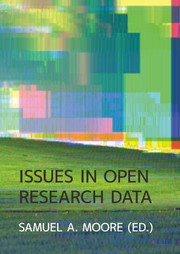
Issues in Open Research Data

Moore, Samuel A. (ed.), Issues in Open Research Data (London: Ubiquity Press, 2014).

Bringing together contributed chapters on a wide variety of topics, Issues in Open Research Data is a highly informative volume of great current interest. It’s also an open access book, available to read or download online and released under a CC BY license. Three of the nine chapters have been previously published, but benefit from inclusion here. In the interest of full disclosure, I’m listed as a book supporter (through unglue.it) in the initial pages.

In his Editor’s Introduction, Samuel A. Moore introduces the Panton Principles for data sharing, inspired by the idea that “sharing data is simply better for science.” Moore believes each principle builds on the previous one:

  1. When publishing data, make an explicit and robust statement of your wishes.
  2. Use a recognized waiver or license that is appropriate for data.
  3. If you want your data to be effectively used and added to by others, it should be open as defined by the Open Knowledge/Data Definition— in particular, non-commercial and other restrictive clauses should not be used.
  4. Explicit dedication of data underlying published science into the public domain via PDDL or CC0 is strongly recommended and ensures compliance with both the Science Commons Protocol for Implementing Open Access Data and the Open Knowledge/Data Definition.

In “Open Content Mining” Peter Murray-Rust, Jennifer C. Molloy and Diane Cabell make a number of important points regarding text and data mining (TDM). Both publisher restrictions and law (recently liberalized in the UK) can block TDM. And publisher contracts with libraries, often made under non-disclosure agreements, can override copyright and database rights. This chapter also includes a useful table of the TDM restrictions of major journal publishers. (Those interested in exploring further may want to check out ContentMine.)

“Data sharing in a humanitarian organization: the experience of Médecins Sans Frontières” by Unni Karunakara covers the development of MSF’s data sharing policy, adopted in 2012 (its research repository was established in 2008). MSF’s overriding imperative was to ensure that patients were not harmed due to political or ethnic strife.

Sarah Callaghan makes a number of interesting points in her chapter “Open Data in the Earth and Climate Sciences.” Because much of earth science data is observational, it is not reproducible. “Climategate,” the exposure of researcher emails in 2009, has helped drive the field toward openness. However, there remain several barriers. The highly competitive research environment causes researchers to hoard data, though funder policies on open data are changing this. Where data has commercial value, non-disclosure agreements can come into play. Callaghan notes the paradox that putting restrictions on collaborative spaces makes sharing more likely (the Open Science Framework is a good example). She also shares a case in which an article based on open data was published three years before the researchers who produced the data published. It is becoming likely that funders will increasingly monitor data use and require acknowledgement of data sources if used in a publication. Data papers (short articles describing a dataset and the details of collection, processing, and software) may encourage open data. Researchers are more likely to deposit data if given credit through a data journal. However, data journals need to certify data hosts and provide guidance on how to peer review a dataset.

In “Open Minded Psychology” Wouter van den Bos, Mirjam A. Jenny, and Dirk U. Wulff share a discouraging statistic: 73% of corresponding authors failed to share data from published papers on request. A significant barrier is that providing data means substantial work. Usability can be enhanced by avoiding proprietary software and following standards for structuring data sets (an example of the latter is OpenfMRI). The authors discuss privacy issues as well, which in the case of fMRI includes a 3D image of the participant’s face. The value of open data is that data sets can be combined, used to address new questions, analyzed with novel statistical methods, or used as an independent replication data set. The authors conclude:

Open science is simply more efficient science; it will speed up discovery and our understanding of the world.

Ross Mounce’s chapter “Open Data and Palaeontology” is interesting for its examination of specific data portals such as the Paleobiology Database, focusing in particular on the licensing of each. He advocates open licenses such as the CC0 license, and argues against author choice in licensing, pointing out that it creates complexity and results in data sharing compatibility problems. And even though articles with data are cited more often, Mounce points out that traditionally indexing occurs only for the main paper, not supplementary files where data usually resides.

Probably the most thought-provoking yet least data-focused chapter is “The Need to Humanize Open Science” by Eric Kansa of Open Context, an open data publishing venue for archaeology and related fields. Starting with open data but mostly about the interaction of neoliberal policies and openness, the chapter deserves a more extensive analysis than I can give here, but those interested in the context against which openness struggles may want to read his blog post on the subject, in addition to this chapter.

Other chapters cover the role of open data in health care, drug discovery, and economics. Common themes include:

  • encouraging the adoption of open data practices and the need for incentives
  • the importance of licensing data as openly as possible
  • the challenges of anonymization of personal data
  • an emphasis on the usability of open data

As someone without a strong background in data (open or not), I learned a great deal from this book, and highly recommend it as an introduction to a range of open data issues.

University Libraries Host Open Education Week 2015

Open Education Week is an annual event to raise awareness of free and open educational resources, and 2015 marked the second celebration of Open Education Week at Virginia Tech’s University Libraries. How are open educational resources (OER) defined?

OER are teaching, learning, and research resources that reside in the public domain or have been released under an intellectual property license that permits their free use and re-purposing by others. Open educational resources include full courses, course materials, modules, textbooks, streaming videos, tests, software, and any other tools, materials, or techniques used to support access to knowledge.

Open Education Week at VT

Virginia Tech students, staff, faculty, and visitors from other institutions gathered for six events the week of February 23-27 to explore, discuss, and learn about open education. Our events focused on raising awareness of Open Educational Resources as:

  • one way to address student debt and educational affordability issues.
  • a way to address copyright limitations in education.
  • a set of tools to enhance faculty creativity, flexibility, and innovation in teaching.

The Student Government Association Academic Affairs Committee hosted two events, one to informally explore student textbook buying experiences and a second event to discuss their own experiences and reflect on their findings.

Students articulated a variety of observations about their own and others’ experiences:

[Students] are not buying books anymore. Books are important for our education. If you’re not buying books, you’re not learning very well.

I took a class where I had to buy eight books. [I] found the cheapest books [I] could find and the total was still $250. . . I don’t think professors know that $250 is a lot of money for [students].

I don’t want to have to work twenty hours a week to afford my textbook.

I had to spend $90 to rent an eBook in order to get a required software code to submit homework. I did not even get to keep the book.

People are going to spend the money on the textbook the professor selected.

I feel helpless. For four classes you have access codes. This leaves students without an option. You need to buy an access code. I don’t know how to get around this. It’s $300, buying access to weekly homework assignments.

Open Education Week Student Panel

Open Education Week Student Panel

Student panelists reflected on their and others’ understanding and responses to textbook buying problems:

I just want faculty to be aware that there is a problem. I have professors who put everything online. Then, I have professors who require purchase of a textbook and homework software.

I’m not privy to faculty pressures; is the content in new editions of textbooks substantially different? [Students] need to ask faculty in a way that is respectful to consider that in their decision-making.

Students mentioned a variety of faculty practices that have been helpful:

  • Recommending, but not requiring a book
  • Putting textbooks and readings on Reserve in the library (“I wish I would have known that these were available as a Freshman.”)
  • Linking content via Scholar (our LMS)
  • One professor mapped changes between different editions so that students could save money

(Slide from David Ernst CC BY; data from Florida Student Textbook Survey)

Students had various reflections on open textbooks/open educational resources:

I would encourage professors to give open educational resources a try, especially if they are teaching the same class year in and out. If they just tried it for a semester especially with these basic classes…the fundamentals don’t change.

Open textbooks mitigate cost. They also change the way we look at textbooks. How have consumers driven product development? Students need to understand their agency as consumers.

I want to tell professors that they would get more recognition if they reduce cost and increase access to [their authored] resources.

As Open Education Librarian, I led the workshop “Get Creative (and stay legal)” introducing educators and authors to OER and open licensing using Creative Commons (presentation slides; see the presentation video below).

Panelists from Virginia Tech and Virginia Military Institute shared their experiences and reflections on open educational resources as students, educators, researchers, authors, and adopters of open educational resources. Mohammed Seyam, doctoral student in Computer Science, discussed the value of openly licensed material as a student, research, and graduate assistant. Heath Hart, Advanced Instructor of Mathematics, reflected on his adoption of an open educational resource and a (subscribed) online textbook in “A Rousing Success and an Unmitigated Disaster.” Greg Hartman, Associate Professor of Mathematics at Virginia Military Institute, discussed his experiences authoring the openly-licensed (CC BY-NC) textbook, APEX Calculus. Peter Doolittle, Executive Director of the Center for Instructional Development and Educational Research, discussed the open education movement from a teaching and learning perspective, moving beyond just content into process.

(Mohammed Seyam 7:45-17:12, Heath Hart 18:06-32:47, Greg Hartman 33:04-50:34, and Peter Doolittle 51:25-1:03:11)

University of Minnesota Open Textbook Library founders David Ernst and Kristi Jensen presented workshops for instructional designers and librarians, highlighting the increased student cost of higher education as state funding decreases, the 800+% rise in the cost of textbooks (4 times the rate of inflation) since 1978, and how open textbooks and openly licensed resources can help alleviate the burden of textbook costs for students and provide faculty with customizable content. Faculty members from a wide variety of disciplines participated in an Open Textbook Adoption Workshop led by Dave Ernst. Faculty were introduced to open textbooks and their potential impact on access, academic success, and affordability, which is especially relevant in the context of rising student debt. Faculty were also invited to review an open textbook from the Open Textbook Library.For more from David Ernst on open knowledge and open textbooks, see his 2013 University of Minnesota TEDx talk and his 2012 Kyoto TEDx talk.

For more information on open educational resources and open licensing, see our OER Guide or contact Anita Walz at arwalz@vt.edu. The University Libraries are exploring additional ways to support faculty interested in open educational resources. We’d love to hear from you!

Open Data Day/CodeAcross Event Recap

Blacksburg’s first celebration of Open Data Day and CodeAcross was organized by Code for NRV, our local Code for America brigade, and the University Libraries, which hosted the event in Newman Library’s Multipurpose Room. Originally scheduled for Saturday, February 21 (the official Open Data Day observed in hundreds of cities around the world), due to rapidly accumulating snow we had to postpone until Sunday. As it turned out, a water leak closed the library around mid-day Saturday, so things worked out for the best. (Our apologies to registrants for the sudden change in plans.)

Open Data Day logo

The first event of the morning was a mapping roundtable led by Peter Sforza, director of the Center for Geospatial Information Technology at Virginia Tech. In addition to looking at a lot of cool maps, we identified three potential areas for collaboration:

  • 3D Blacksburg – an effort to develop a common, shared 3D spatial reference model for Blacksburg and the New River Valley.
  • Contributing more authoritative data to OpenStreetMap for Blacksburg and Virginia by working with GeoGig.
  • Opening data that CGIT compiles for projects and research, for example crash data from the Virginia Department of Transportation.
Mapping Roundtable

Peter Sforza Leads the Mapping Roundtable

For the journalism roundtable, we were joined by Scott Chandler, Design/Production Adviser for the Educational Media Company at Virginia Tech, and Cameron Austin, former editor of the Collegiate Times. One problem the CT has is finding/keeping programmers to help with data, such as their academic salaries database. Code for NRV will try to help with recruitment. A database of textbook costs was identified as a possibility to work on that would be of particular interest to students.

Blacksburg town council member Michael Sutphin joined us for the public policy roundtable, which included interesting discussions of town planning notifications and ways to encourage citizen engagement (such as the underutilized site Speak Up Blacksburg). Some of the project ideas included:

  • Visualizations of the town’s historical budget data that could benefit the public and town officials.
  • Opening the raw data used to create tables and maps in the town’s comprehensive plans.
  • Analysis of emails to and from local government officials to create visualizations of the most commented on topics in the town, e.g. word clouds and tag lists.

Our hackathon emerged from the morning’s mapping roundtable, so perhaps it’s not surprising that the projects were geographic in nature:

  • One volunteer used the Virginia Restaurant Health Inspection API created by Code for Hampton Roads to create a map of Blacksburg restaurants and their health scores.
  • An architecture student started a project that will use open 3D geospatial data from Virginia Tech to design pathways that are sculpted for the landscape.
  • Researchers from the Virginia Bioinformatics Institute adapted a model used in Ebola research to optimize placement of EMS staging areas during flood emergencies in Hampton Roads, Virginia. The model uses open data sets like the location and elevation of every roadway in Virginia to determine which streets would still be navigable during a flood.
Waldo Jaquith

Waldo Jaquith

To kick off our events Friday evening, we were very happy to have Waldo Jaquith speaking on “Open Government Data in Virginia” prefaced by a brief introduction to Open Data Day/CodeAcross by Ben Schoenfeld, co-leader of the Code for NRV brigade. Waldo Jaquith is the director of the U.S. Open Data Institute, an organization building the capacity of open data and supporting government in that mission. See the video of his talk below.

Thanks to everyone who turned out Friday and/or Sunday!

Thanks to the University Libraries’ Event Capture Service for the video below.

Learn About Open Data at Open Data Day/CodeAcross!

Join us for Blacksburg’s first observance of Open Data Day/CodeAcross, organized by Virginia Tech’s University Libraries and Code for NRV, our local Code for America brigade, this Friday and Saturday, February 20-21, 2015. We will be one of more than 100 Open Data Day and CodeAcross events taking place around the world on February 21. We welcome area residents and local government officials as well as faculty, staff, and students at Virginia Tech to find out how open data can improve our community (coding not required!). Registration is requested to help us with logistics, and for VT faculty, NLI credit is available (look for the sign-in sheet as well).

Waldo Jaquith

Waldo Jaquith

Friday, February 20, 2015
5:30pm to 7:00pm
Newman Library Multipurpose Room (first floor)

To kick off our events, we are very pleased to have Waldo Jaquith speaking on “Open Government Data in Virginia” which will be followed by a brief introduction to Open Data Day/CodeAcross. Waldo Jaquith is the director of the U.S. Open Data Institute, an organization building the capacity of open data and supporting government in that mission. In 2011, in acknowledgement of his open data work, Jaquith was named a “Champion of Change” by the White House and, in 2012, an “OpenGov Champion” by the Sunlight Foundation. He went on to work in open data with the White House Office of Science and Technology Policy. Jaquith, a 2005 Virginia Tech graduate, lives near Charlottesville, Virginia with his wife and son.

Open Data Day logo

Saturday February 21, 2015
9:30am to 5:00pm (lunch provided)
Newman Library Multipurpose Room (first floor)
Registration requested!

Open Data Day/CodeAcross will offer three tracks for coders and non-coders alike. First, there will be a sequence of one-hour discussion roundtables led by experts on the relationship of open data with mapping (10am), journalism (11am), public policy (1pm), health (2pm), and research (3pm). Second, there will be a mapping project emerging from the mapping roundtable and lasting the rest of the day. Third, for the coders there will be a hackathon using open government data in Virginia. Around 4pm, we will gather together, talk about our projects and what we learned, and plan for the continuation of projects. Attendees may move between these three strands as they like- or just come for one roundtable. Lunch is provided! While all events are free and open to the public, please register online to help us plan for the roundtables, lunch, and wireless access for those without a Virginia Tech affiliation. If you have questions, please contact me, Philip Young at pyoung1@vt.edu or 540-231–8845. Hope to see you there! #OpenDataDay #CodeAcross

CodeAcross logo

Open Education Week 2015 at Virginia Tech

The University Libraries is planning its first observance of Open Education Week (February 23-27) at Virginia Tech! Open Education Week is intended to raise awareness of open educational resources (OER), which include a wide range of teaching, learning, and research resources such as textbooks, videos, software, and course materials that are free to be used and re-purposed. All are welcome to attend and find out how adopting, adapting, and authoring openly licensed resources can advance learning and reduce costs for students. We’re especially pleased to have Kristi Jensen, Program Development Lead for the eLearning Support Initiative (University of Minnesota Libraries) and David Ernst, Chief Information Officer (University of Minnesota College of Education and Human Development) from the University of Minnesota Open Textbook Library who will host the workshops on Thursday and Friday.

  • Interested in learning more about the conceptual and practical aspects of open licensing? Join us on Tuesday, Feb 24 11am-12:30pm in Newman Library’s 1st Floor Multipurpose Room for the interactive presentation “Get Creative (and Stay Legal).”
  • Wondering what students have to say about affordability of learning resources and how this affects them? Come to the Student Government Association-hosted panel discussion on Wednesday, Feb 25th 12:30-1:45pm (Newman Library’s 1st Floor Multipurpose Room).
  • Want to meet faculty who have authored or are implementing openly licensed resources/open textbooks in their courses? Join us for an Open House at 3:30pm Wednesday, Feb 25th and stay for the panel discussion from 4-5:30pm (Newman Library’s 1st Floor Multipurpose Room). Panelists include Peter Doolittle, Mohammed Seyam, Heath Hart, and Greg Hartman (VMI).
  • Do you advise or assist faculty regarding learning materials or instructional design? Do you work or are studying instructional design? Join us for an interesting conversation about open educational resources (OER) and instructional design on Thursday, February 26th 11am-12:15pm (with Kristi Jensen and David Ernst, Newman Library’s 1st floor Multipurpose Room).
  • Do you work in an area academic library and want to be better equipped to talk with faculty about exploring open educational resources? Register for the Open Educational Resources for Librarians workshop on Thursday, February 26th 1-2:30pm (with Kristi Jensen and David Ernst, Newman Library Boardroom, 6th floor).
  • Are you a faculty member responsible for reviewing or selecting textbooks or other learning materials? Are you looking for other options or concerned about the costs for students? Join us for the Open Textbook Adoption workshop Friday, February 27th 9-11am. A limited number of $200 stipends are available for teaching faculty who apply, attend the workshop, and write a review of an open textbook (with Kristi Jensen and David Ernst, Newman Library’s 1st Floor Multipurpose Room).

Open Education Week at VT

Why are we hosting Open Education Week?

The cost of textbooks and learning resources is a burden for students:

Faculty are saving their students money by adopting OER:

And OER gives faculty opportunities for innovative teaching and learning:

  • Faculty may create a new resource or customize an openly licensed resource to make it best fit their learning objectives.
  • Openly licensed content may be copied, updated, reformatted, customized, and redistributed free of charge. This gives a tremendous opportunity to faculty (and students) who wish to integrate content into new and different learning resources (for example, changing the formatting of a book to enhance student interaction with the text, or pulling content into different platforms, or customizing problem sets, assessments, and links to other resources).

See our Open Education Week guide for more information on events as well as OER in general. Please contact Anita Walz at arwalz@vt.edu or 540-231-2204 with any questions. Hope to see you at one or more Open Education Week events! #openedweek #openeducationwk

Open@VT on Mastodon

  1. Loading Mastodon feed...